
Hi Jason,
How are you? I’m sorry it’s taken me two years to write this, but Michael’s passing was so sudden I couldn’t quite get it together to express anything - even for the beautiful memorials that you arranged. But I am sending this to you now.
Again, I hope you are well and that Michael’s Foundation is flourishing.
All best,
Marrin
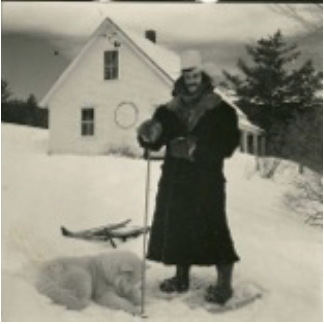
Now that two years have gone by since Michael’s passing, I finally can write about him and his work.
I first encountered Michael’s artwork in a Sculpture exhibit at the Guggenheim museum in the early 1980s. As a graduate student in painting, I was fascinated by the show and on my return to the university, I started researching the two artists that impressed me the most -Michael Singer and Eva Hesse. While clearly different, both artists made work that communicated through their own unique visual language. The sculptures felt both raw and emotional.
Eva Hesse had passed on a decade earlier, but as I researched Michael, I discovered a photo of him printed next to one of his sculptures where he was representing the United States at the San Paolo biennale in Brazil. The photo surprised me as it didn’t seem to fit the sculptures I had seen. His sculptures spoke of an intimacy, of secrets in the process of being revealed, of a narrative in a language that I didn’t quite understand but which communicated nevertheless through symbols. There was a sense of transcendence above the common experiences of this world- a spirituality, a beauty, a yearning and above all, a questioning that all seemed part of his unique visual language.
The sculptures reminded me of what I experienced visiting archaeological ruins in Egypt and Greece- left over markings, remnants of great ancient cultures. It was like being given a map or a code made up of ancient traces of a culture, artifacts left to us to be deciphered by those who could imagine and try to recreate what had once been. I could imagine a show of his work juxtaposed with ancient artifacts. The visual dialogue between the two would be fascinating!
Michael’s sculptures feel like they invite you into his personal world of complex psychology, symbolism and renewal. When Michael finally taught a course at Marlboro College, he gave his class an essay by Mircea Eliade. Eliade, known for his “profound insights into the nature of religious experience and myth” was I think, pivotal to Michael’s own work as an artist. This is indicated in the titles of
his sculptures- “First Gate, Ritual Series,” “Ritual Series Syntax,” “Cloud Hands, Ritual Series,” “Ritual Series/Retellings,” “Ritual Series, Map of Memory.”
In addition, Michael created a whole series of prints similarly titled- “Moon, Ritual Series,” “Ritual Series Guardian Meditation,” and “Ritual Series, Map of Memory." Throughouthislifehecontinuedtoworkinbothmediums–Sculpture and Printmaking. The chapter “art as process and experience as ritual interaction” in Elsa Marie Bukdahl’s book on Michael's work, show how these two mediums fed each other.
But I’m jumping ahead of the story.
Because when I saw the photograph of Michael, I was looking at someone who resembled a businessman dressed in a three-piece suit. He looked like one of those ambitious New York artists who had control of the art world and played it as if it was a business venture. The photo confused me, and I thought, “I don’t want to meet him.”
Then, a couple of years after completing my M.F.A. I was offered a job at Marlboro College in Vermont. And, at the end of the interview, they mentioned that Michael Singer lived in the area. “Oh, I love his work!” I replied. But inside I was remembering that photograph which I didn’t like.
Being from New England, I was thrilled to take the job at Marlboro, just a couple of towns away from where my grandfather, Aldro Hibbard had spent his years painting snow scenes from the local landscape. But after a year of living in Brattleboro, Vermont with my main entertainment being an aerobics class, a young man who also worked out at the same gym asked me if I would accompany him to visit the artist, Michael Singer’s studio. I told him I’d love to see the studio but had never met the artist himself. The young man looked surprised at my response, and said, “But he’s in your aerobics class!”
Now there were only three guys taking the class and one of them looked like Einstein – but none of them resembled the photo I had seen from the San Paolo biennale. So, when we went to the studio, and I met the guy from my aerobics class who looked like Einstein, I finally said, “I’m a little confused. I saw a photo of you printed in a book about the San Paolo biennale...” and didn’t even manage to finish my sentence before Michael burst into a fit a laughter. “It worked, it worked!” he exclaimed.
Then Michael explained how he didn’t like to have his photo taken, but since the organizers of the biennale insisted, he finally cut out a photo from a men’s magazine, had his photographer take a picture of it, and sent it in!
Since he had no intention of attending the biennale himself, he didn’t think anyone would take notice of the deception. His assistant Bob, who went to Brazil to assemble Michael’s piece, was asked, “What does Michael look like?” but he simply replied, “He’s handsome.” And, this was the first time Michael had met anyone who had been duped by the joke which delighted him immensely.
I, on the other hand was so relieved he wasn’t the guy in the photo. The man standing in front of me felt just like the work I admired.
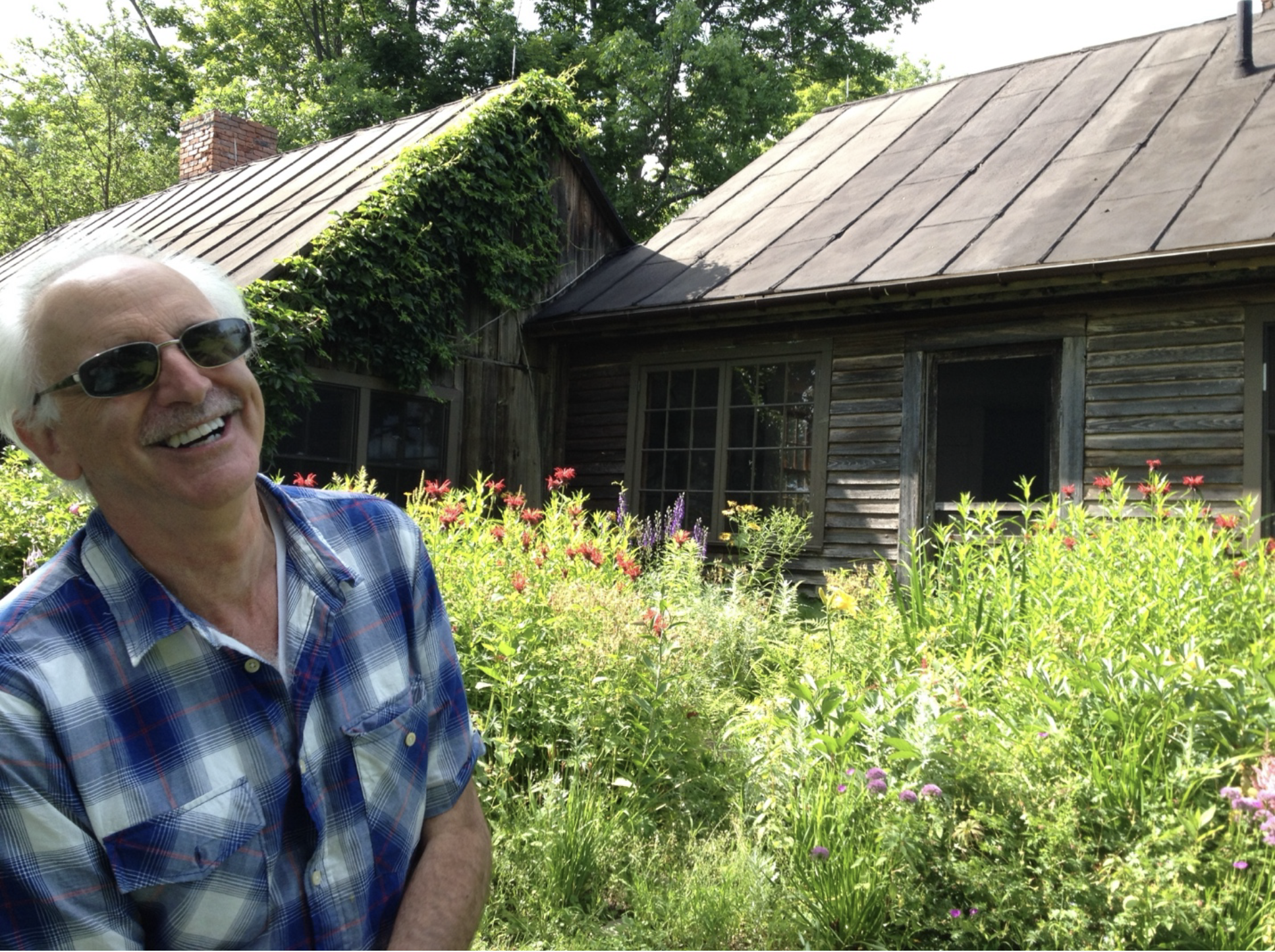
Michael in his garden, (Photo by Marrin)
Our friendship developed very slowly. I met Michael in 1992 and although we saw each other multiple times a week in our aerobics class, I don’t think we became friends until a little later when he accepted my invitation to give a talk at Marlboro College. This was part of a series on Creativity, funded by an NEH grant where I and my colleague Geraldine Batlle invited famous speakers who lived in the area. Other speakers included Saul Bellow, Wolf Kahn, John Kenneth Galbraith, and Pat Adams. It was very generous of our distinguished “neighbors” to agree to come to this small liberal arts college of only 250 students!
After the talk, we usually invited the speaker to a dinner at Geraldine’s house, with other faculty. But Michael requested to skip that group event and just have a dinner with me at a fancy restaurant (the only fancy restaurant at the time) in Brattleboro. The committee agreed, and that’s how our friendship began.
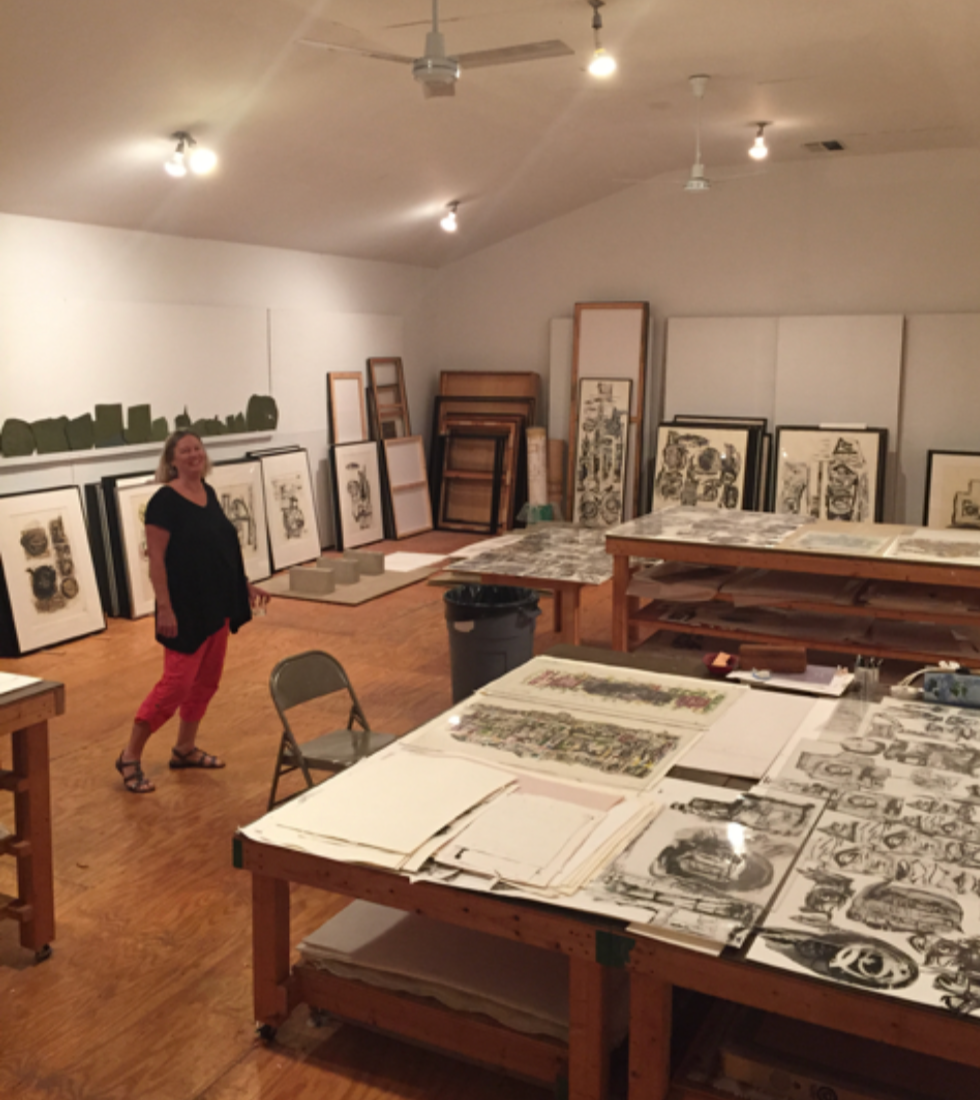
Marrin in Michael’s print studio, (Photo by Kim Benzel)
Now, sitting in my studio in New Mexico, I realize what a profound effect Michael has had on my own experience as an artist. Over the years, I had many opportunities to visit his studio. There I could wander at my leisure through the sculptures watching them grow and change over time. The pieces evolved slowly over years, and it was such a privilege to be able to watch that
process. He also added on buildings and renovations to his property including the print studio, more sculpture studios and finally building an addition onto the orginal old Vermont house that had been his escape from the artworld back in the 70s. On his property he created a whole environment that became a work of art in itself.
Eventually, he spent more and more time with his public work projects, working with teams of engineers and architects, which he very much enjoyed; but the sculptures and prints remained the core of his artistic process.
The day Michael passed on, I walked into a thrift store in Santa Fe and saw an old wooden table that I knew Michael would have liked. (His home, like his studios, felt like entering an artistic world that was uniquely his own.) I had no idea what was going on with him that day, but it was as if his spirit was guiding me to that table which now sits in my living room. It always reminds me of him, of his unique, individual spirit that created and captured a beauty that transcends time.
Marrin Robinson, Santa Fe, March 2026
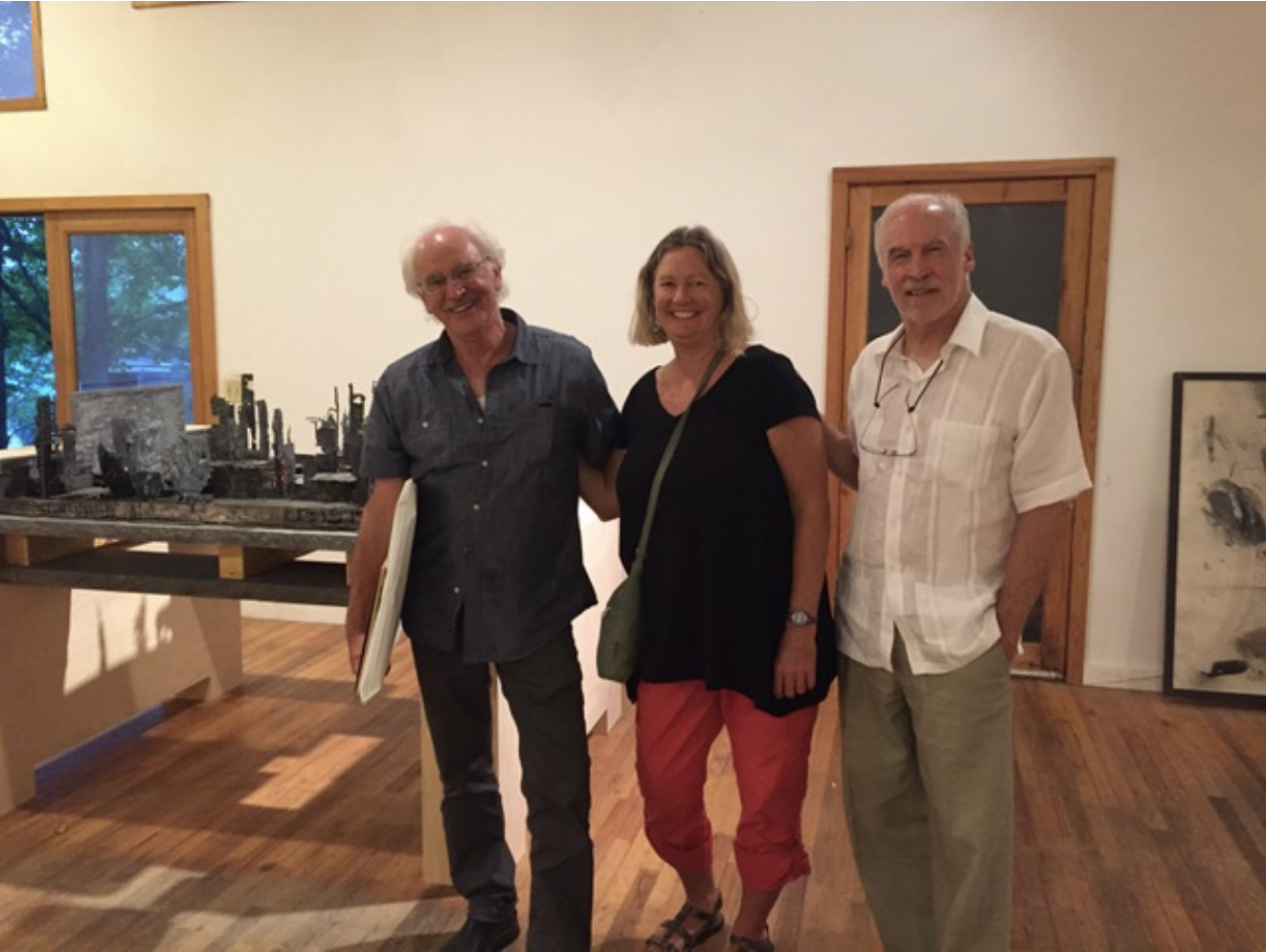
Michael, Marrin and Bruce in Michael’s sculpture studio, (Photo by Kim Benzel)
______________________________________________________
The following is an excerpt from T. Wilson’s introduction to Michael Singer’s talk at Marlboro College, 1993.
I first heard of Michael Singer, though not by name, from my neighbors, They told me that a strange man had showed up on their doorstep one November wanting to know if it was all right with them if he borrowed their beaver swamp. He toppled hemlocks across one another and draped fat hemp ropes across the space. It looked as if a little storm had burst across the pond, and he came back from time to time to see how it was doing, and they got to know him.
I have since seen more of Michael's work, in the Museum of Modern Art, in association with their show Primitivism in Modern Art, and at the Walker Art Center. That work still carried the air of the natural world and an association with primitive forces and sacred houses of stone and wood into the stark, square spaces of the galleries. John Russell, writing in The New York Times, said of him:
“He works slowly and he allows nature her full share. Nature's sticks and stones, nature's bamboos and grasses are recruited, but not violated. The work proceeds at nature's pace, and in the end-result, art and nature link arms and agree to live together. . . . We are face-to-face with the sense of balance. . . , the feeling of leafless environment, and the merciful unaggressiveness of the whole.”
...Michael has lived for twenty years in what one of his exhibit catalogs describes as a remote area in Vermont, which is to say, right here, so please welcome our friend and neighbor, Michael Singer.